Quick answer
A fuse box that buzzes loudly, crackles, feels hot or smells of burning is not normal and may have loose connections, an overloaded or failing breaker or arcing. Do not open it. If it is getting hot and it is safe to reach, switch off the main switch, then call an electrician. If there is smoke or fire, call 999.
Never open the consumer unit cover or touch anything inside it; if you see smoke, flames or scorch marks, leave the area and call 999.
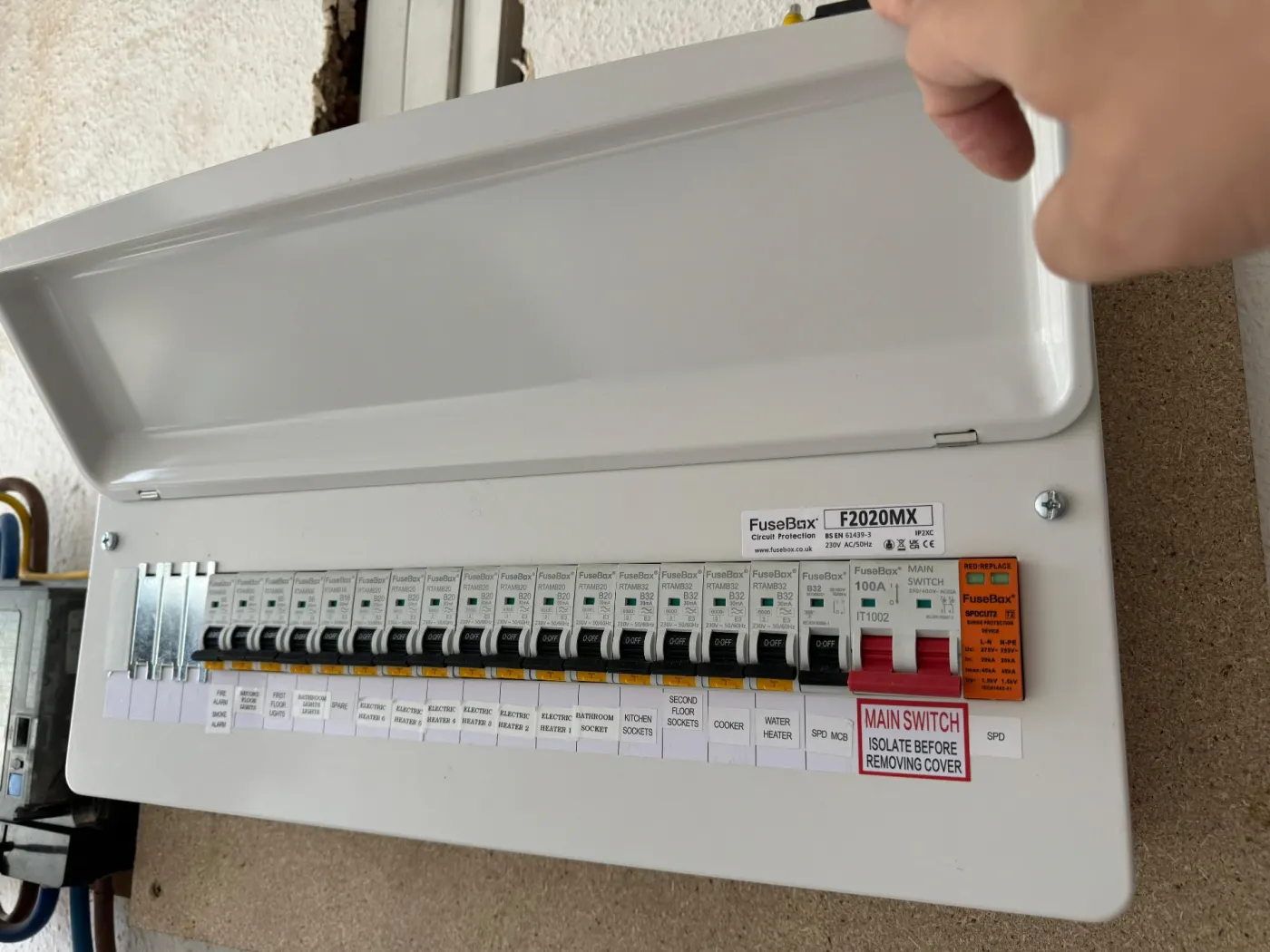
Reading your consumer unit (fuse board)
- 1Main switch. Turns off the power to the whole property. It rarely trips by itself.
- 2RCD. Protects a bank of circuits. If it's down, every circuit after it is off.
- 3Circuit breakers (MCBs). One per circuit, such as kitchen sockets or upstairs lights.
- 4Tripped. A switch pointing down has tripped. Here, only that one circuit is off.
Is it normal for a fuse box to hum?
A very faint hum can be normal. Some RCDs, timers and doorbell transformers near the consumer unit can make a quiet, steady sound, particularly in a silent house. A faint hum that has always been there, with no heat or smell, is usually not a concern.
A new sound, a louder sound or one that changes is different and should be checked.
If you are not sure whether a sound is normal, notice whether it is new, whether it has changed, and whether it is linked to heavy use such as an oven or shower running. Sounds that appear with load are a stronger warning than a constant, faint hum.
If the sound is quiet, there is no heat, smell or scorching, and everything works normally, it is reasonable to arrange a check without panic. If the sound grows louder or any warning sign appears, switch off the main switch if it is safe to reach.
What is not normal?
Treat any of the following as a sign of a fault:
- Loud buzzing, sizzling or crackling.
- A casing or cover that feels warm or hot.
- A burning or fishy smell.
- Scorch marks or discolouration on the casing.
- Switches that trip repeatedly, or will not stay on.
- Lights that flicker or dim for no clear reason.
What causes a consumer unit to buzz or get hot?
The usual causes are:
Heat is the key danger. Resistance at a loose terminal turns electrical energy into heat, which can soften plastic and damage insulation, and in the worst case start a fire inside the enclosure.
- Loose connections inside the unit, which create resistance and heat when current flows.
- An overloaded circuit, where the load is more than the breaker is meant to carry.
- A failing or worn breaker (MCB) that is not making good contact.
- Arcing, where electricity jumps across a poor connection.
- A failing RCD, which can buzz or run warm.
- An ageing unit that has simply reached the end of its life.
What should I do if my fuse box is hot or buzzing loudly?
Do not open the cover and do not try to tighten or move anything. Then:
Do not try to isolate the problem by flicking individual breakers on and off repeatedly, and do not spray or wipe anything on the unit. Leave the cover closed.
- If there is smoke, flames or a strong burning smell, leave the building and call 999.
- If the unit is hot but there is no fire and it is safe to reach, switch off the main switch.
- Do not switch the power back on until it has been inspected.
- Unplug sensitive appliances if you can do so without touching the consumer unit.
- Call an electrician as soon as possible.
Why is the main switch warm?
The main switch handles all of the current used in the property, so a very slight warmth can occur when many appliances are running. But if it is noticeably hot, or hotter than the other switches, it can be a sign of a loose or failing connection. Treat that as a fault and have it inspected.
What about old fuse boxes?
Older installations may have rewireable fuses, where a thin piece of fuse wire is fitted in a ceramic holder, or a consumer unit mounted on a wooden backboard. Wooden backboards burn more easily than modern non-combustible enclosures, and rewireable fuses can be fitted with the wrong wire, which makes them less reliable at protecting circuits.
These units may not provide RCD protection, which modern safety standards expect. An electrician can inspect your unit and tell you whether it is safe to keep. Signs that point towards replacement include heat, buzzing, scorch marks, a wooden backboard, rewireable fuses or no RCD protection. See our guide to consumer unit replacement for more detail.
Replacing a consumer unit also gives the chance to fit modern protective devices, labelled circuits and a metal enclosure.
Can an electrician fix a buzzing fuse box?
Often yes. After testing the installation, the electrician may be able to tighten connections or replace a failed breaker or RCD. If the unit is damaged by heat, is very old, or can't be repaired, they will usually recommend a replacement consumer unit. The work is carried out after testing and is signed off with the correct certification.
What will an electrician check?
An electrician will test the installation, look for signs of heat damage at the main switch, breakers and connections, and check that the earthing, bonding and RCD protection are suitable. They will also look at the cables entering the unit, and check whether any circuits are overloaded.
A report such as an EICR can also show wider issues in the installation, which is useful if the fuse box is old or you do not know its history. Where the unit is damaged, they can advise whether a repair is realistic or whether a consumer unit replacement is the safer choice.
When to call an electrician
Call an electrician straight away if the fuse box is hot, buzzing loudly, crackling, scorched or smells of burning. PowerArc covers East London and Essex, and you can reach our 24/7 emergency line on 07775 512758 at any hour. If you see smoke or flames, call 999 first.
General information for homes in England, written by the electricians at PowerArc Ltd, Hornchurch. Last updated 16 October 2026. For advice on your own property, speak to one of our electricians.