Quick answer
When half the house has no power, a protective device in your consumer unit has usually tripped. In a split-load unit, one RCD covers a bank of circuits, so when it trips everything on that side goes off. Check the consumer unit for a switch that is down, unplug appliances on the dead circuits, then push the switch back up. If it will not stay on, call an electrician.
Do not open the consumer unit or fuse box cover or touch any fuse wire, and if a switch will not stay on, or you smell burning, leave it off and call an electrician; if there is a fire, call 999.
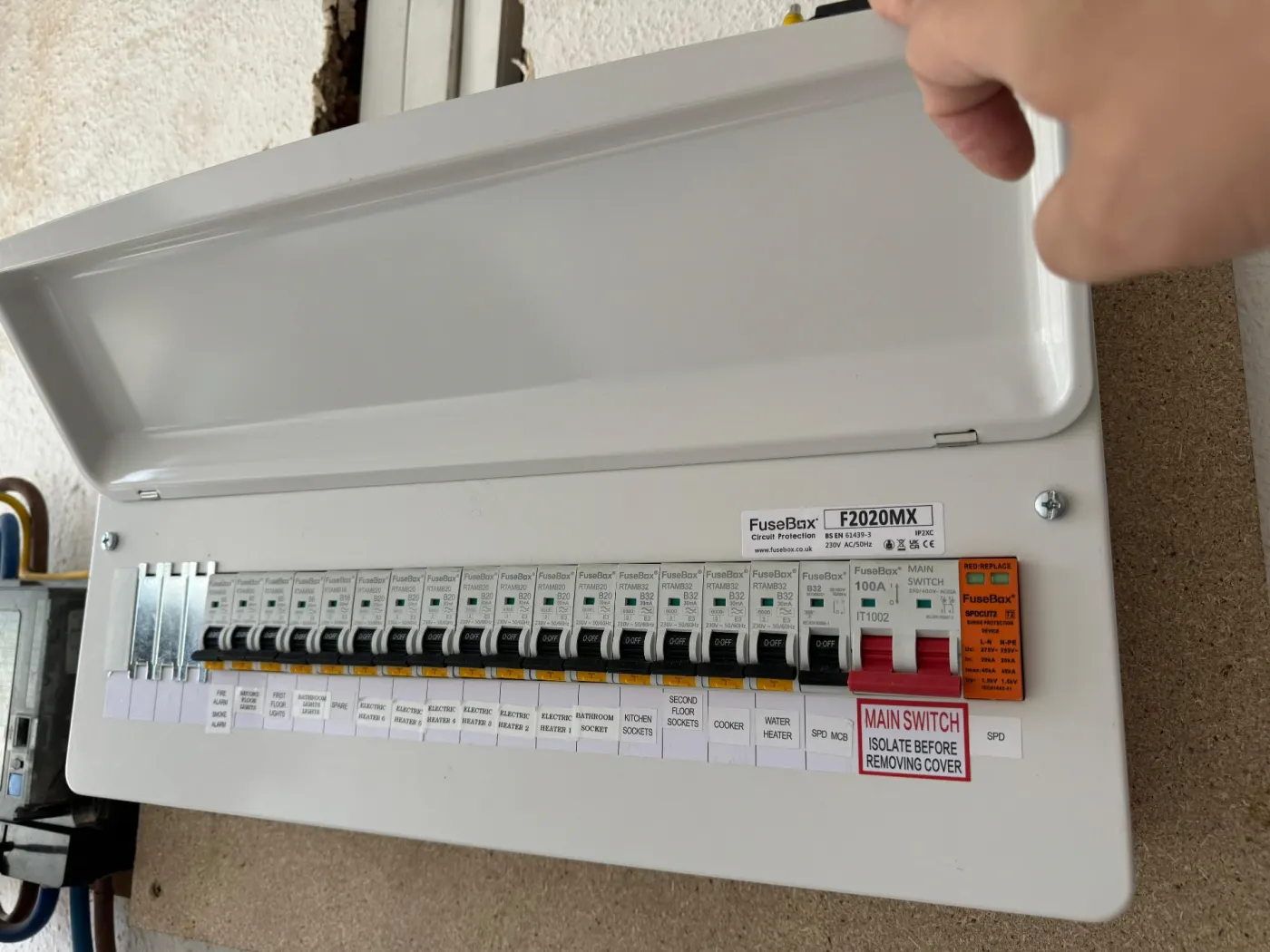
Reading your consumer unit (fuse board)
- 1Main switch. Turns off the power to the whole property. It rarely trips by itself.
- 2RCD. Protects a bank of circuits. If it's down, every circuit after it is off.
- 3Circuit breakers (MCBs). One per circuit, such as kitchen sockets or upstairs lights.
- 4Tripped. A switch pointing down has tripped. Here, only that one circuit is off.
Why has half my house lost power?
Most homes have their electricity split into several circuits, such as lighting, sockets, cooker and shower, each protected by its own device. When a fault develops on one circuit, the device protecting it switches off the supply to that circuit. Sometimes that takes out a larger group, which is why a whole floor or half of the house can go dark at once.
The key questions are how your consumer unit is arranged and which switch has operated.
What is a split-load consumer unit?
A split-load consumer unit has two groups of circuits, each protected by a different RCD, plus a main switch. One RCD might cover downstairs sockets, the other lights and upstairs sockets. In some units, one RCD covers many circuits while others are protected only by individual MCBs.
If a fault is on a circuit behind an RCD, the RCD trips and every circuit it protects loses power. That is how a single faulty appliance on a ground-floor socket can leave half the house off. Newer units with RCBOs avoid this by protecting each circuit individually, so a fault only takes out its own circuit.
What could be causing the loss of power?
Several things can leave part of a house without power.
- A tripped RCD covering a bank of circuits, usually because of a faulty appliance or an earth leakage fault.
- A single tripped MCB or RCBO, for one circuit that is overloaded or has a short circuit.
- A blown fuse in an old fuse box with rewireable fuses, where a thin wire inside a carrier has melted.
- A single circuit fault, such as a damaged cable or failed fitting, with no tripped switch visible.
- The main switch having been turned off or tripped.
How do I tell which one it is?
Look at the front of the consumer unit without opening the cover. A tripped switch will sit in a different position from the others, usually down or in the middle. If there is a large RCD switch down, it is a bank of circuits. If one small switch is down, it is one circuit.
In an older fuse box with ceramic or plastic fuse carriers, a blown fuse is not always visible from the front. Do not pull out the carriers to look. Instead, note which rooms are dead and call an electrician if you cannot identify a tripped switch.
How to find the fault safely
Work through these steps in order. They only involve unplugging items and operating switches.
- Check whether it is just your home. If a neighbour is also without power, it is likely a power cut and not your wiring.
- Look at the main switch at the end of the consumer unit. If it is off, push it back up. If all power is off and the main switch is on, check the RCD switches.
- Look for any switch that is down. Leave the others as they are.
- Switch off and unplug appliances on the dead circuits. Include anything you recently plugged in or used when the power went.
- Push the tripped switch firmly up. If it stays on, plug appliances back in one at a time, leaving a few minutes between each.
- If an appliance causes the trip again, leave it unplugged and reset the switch.
- If the switch will not stay on with everything unplugged, or trips straight away, leave it off. Do not try again repeatedly, and call an electrician.
What if I have an old fuse box with rewireable fuses?
Older fuse boxes use fuse carriers with a replaceable wire, or cartridge fuses. When one blows, a circuit goes dead, but you cannot always tell which from the front. Changing a fuse wire means handling live equipment, so it is not a safe DIY job and fuse boxes of this age often do not have RCD protection.
If you have this type of box, call an electrician when a circuit dies. They can find out why it blew and advise on upgrading to a modern consumer unit.
What if everything is off, not just half?
First check the main switch on the consumer unit and any RCD switches. Then look outside. If streetlights are off or neighbours have no power, there is probably a power cut on the network. Call 105 for free to report it or get information.
If neighbours have power and only you do not, and the consumer unit looks normal, the problem may be at the meter or incoming supply. In that case, call an electrician or your network operator, depending on where the fault lies.
When to call an electrician
Call an electrician if a switch will not reset, keeps tripping, or if you cannot find which circuit has failed. Call as well if the dead area includes a circuit you rely on, such as a fridge, heating controls or medical equipment, or if there is a burning smell, buzzing or scorch marks.
A qualified electrician can find the fault with proper test equipment and make it safe. PowerArc has a 24/7 emergency line on 07775 512758 if you are left without power in part of the house.
General information for homes in England, written by the electricians at PowerArc Ltd, Hornchurch. Last updated 16 October 2026. For advice on your own property, speak to one of our electricians.