Quick answer
A plug socket that has stopped working is most often caused by a blown fuse in the plug, a tripped switch at the consumer unit, or a faulty appliance. Try the appliance in another socket, check the plug fuse, and look for a tripped switch. If one or more sockets stay dead, an electrician needs to find the fault.
Never test a socket with a screwdriver, a wet finger or any metal object, and never remove the socket faceplate or touch the wiring.
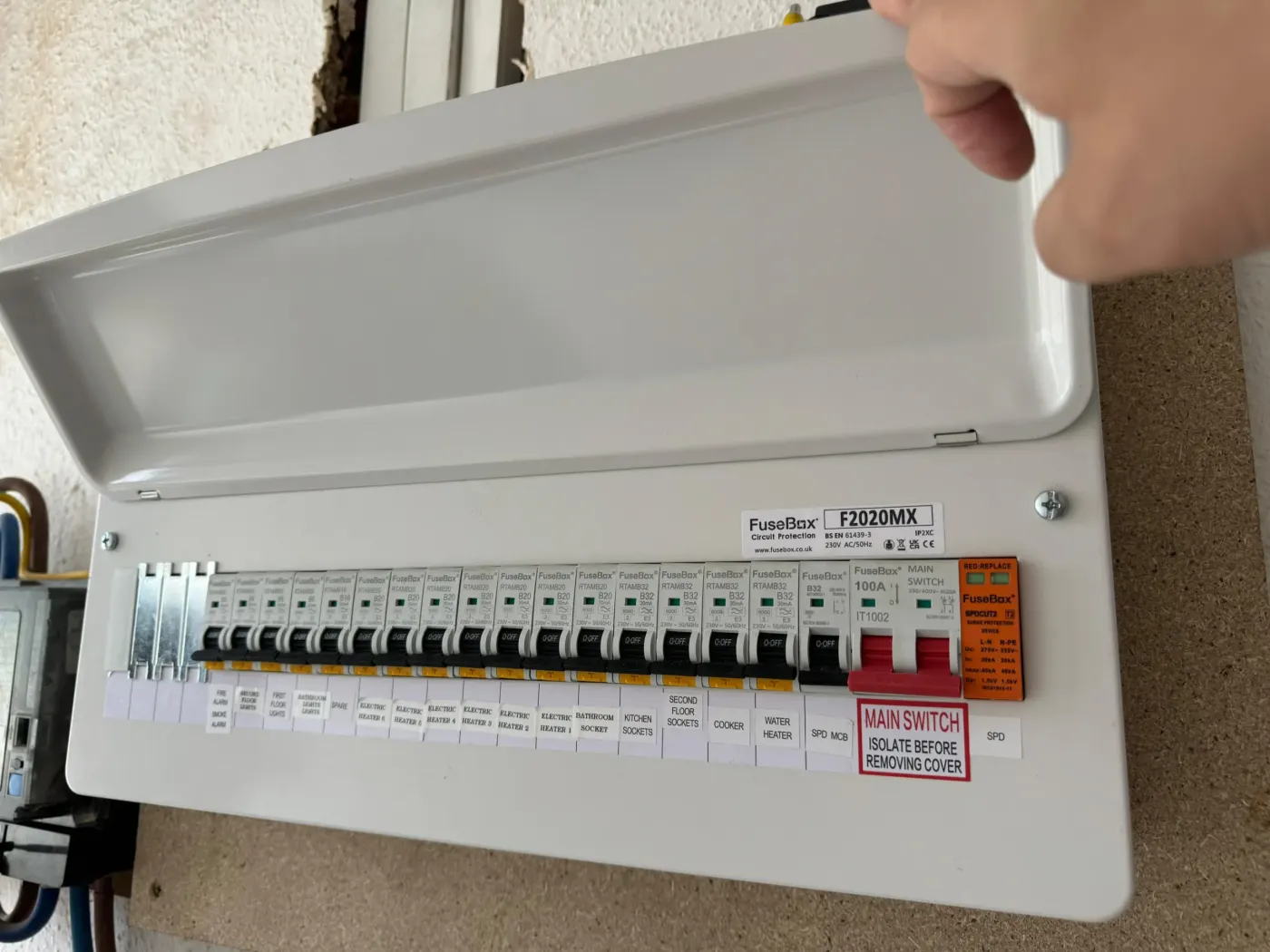
Reading your consumer unit (fuse board)
- 1Main switch. Turns off the power to the whole property. It rarely trips by itself.
- 2RCD. Protects a bank of circuits. If it's down, every circuit after it is off.
- 3Circuit breakers (MCBs). One per circuit, such as kitchen sockets or upstairs lights.
- 4Tripped. A switch pointing down has tripped. Here, only that one circuit is off.
Is it the socket or the appliance?
Start by finding out whether the socket or the appliance has failed. Plug the same appliance into a different socket that you know works. If it still does not work, the fault is with the appliance or its plug. If it works elsewhere, the original socket is the problem.
If a different socket works but a particular appliance does not, check the appliance's own cable and plug for damage and look at its instructions. Do not keep trying a faulty appliance in several sockets, as a fault in the appliance can trip circuits.
Could the plug fuse have blown?
UK plugs contain a cartridge fuse to BS 1362. If the fuse blows, the appliance goes dead even though the socket is fine. Fuses are normally 3 amp or 13 amp. Lower-power appliances such as lamps, TVs and chargers usually need a 3 amp fuse, and high-power ones such as kettles, heaters and irons usually need 13 amp. The right rating is on the appliance label or in its instructions. Fuses are small, cheap and designed to fail first, so a blown plug fuse is the single most common reason an appliance suddenly stops working, and it is worth checking before anything else.
To check, unplug the appliance, and unscrew the fuse cover on the plug. Replace the fuse with a new one of the same rating, and do not fit a higher rating than the appliance needs. If the new fuse blows straight away, the appliance or its cable is faulty and should not be used.
Has a switch tripped at the consumer unit?
Your consumer unit, often called the fuse box, contains switches that cut the power to a circuit if there is a fault. If a socket circuit has tripped, the sockets on it will be dead. Look at the switches, without removing the cover. If one is in the down or off position, or the main RCD has tripped, switch off and unplug everything on that circuit before resetting it.
If it trips again straight away, leave it off. The fault could be in an appliance or in the wiring, and an electrician should look at it.
Is the socket on a switch, a spur or its own circuit?
Some sockets have a switch that must be on. Others, such as those for a fridge, boiler or built-in appliance, may be fed from a switched fused spur, which is a small unit on the wall with its own fuse and switch. Check that it is switched on and that its fuse, if it has a visible one, is fine.
Cooker, shower and some outdoor sockets can be on separate circuits with their own switch at the consumer unit, so a dead socket might not share a cause with the rest of the house.
What if a USB socket is not working?
USB sockets have electronics inside, and they can fail even when the standard socket part is fine. Try a different cable and charger first. If the 13 amp part of the socket works but the USB part does not, the socket may need replacing by an electrician.
What if several sockets are dead?
In many homes, sockets are wired in a ring circuit, a loop of cable that starts and ends at the consumer unit. If a connection fails somewhere on that loop, some sockets may still work while others do not, and the circuit can carry more current than it should through the remaining path. This is called a broken ring, and it can be a hidden safety problem.
A dead socket or group of sockets that is not explained by a trip or a blown plug fuse needs to be tested by an electrician. Do not try to find the break yourself.
An electrician tests ring circuits with specialist instruments. If you rely on an extension lead from another room in the meantime, keep to low-power items only and unwind the lead fully.
What safe checks can I do?
These are the checks you can safely carry out:
- Try the appliance in a different socket.
- Try a different appliance in the dead socket.
- Check the plug fuse is the correct rating and replace it if blown.
- Check the socket's switch, if it has one, and any switched fused spur.
- Look at the consumer unit for tripped switches, without opening the cover.
- Check whether other sockets or lights are also dead.
- Look for scorch marks, cracks or a burning smell, and if there are any, stop and call an electrician.
Why does the socket only fail some of the time?
Intermittent faults are usually caused by a loose plug fit or a worn contact inside the socket, a loose connection behind the faceplate, or a damaged appliance cable that only makes contact in certain positions. These can also create heat, so look for warm plugs, scorch marks or a burning smell.
If a plug feels loose in a socket, or you have to wiggle it to get power, stop using that socket. A worn socket can be replaced by an electrician, and it is not worth waiting for it to fail completely.
When to call an electrician
Call an electrician if the socket is dead and the checks above do not explain it, if more than one socket has stopped working, if a switch keeps tripping, or if you notice any heat, smell or scorch marks. PowerArc covers East London and Essex, and our 24/7 emergency line on 07775 512758 is available if the problem cannot wait.
General information for homes in England, written by the electricians at PowerArc Ltd, Hornchurch. Last updated 16 October 2026. For advice on your own property, speak to one of our electricians.