Quick answer
An RCD that trips at night is usually responding to something on a timer, such as an immersion heater, storage heaters, a delayed-start dishwasher or washing machine, or garden lighting. One that trips in the rain usually points to water getting into outdoor sockets, lights, junction boxes or the cable to an outbuilding. Note the time or weather, switch off the suspect item and reset.
Never touch outdoor electrical fittings or cables that are wet or damaged, and do not keep resetting an RCD that trips straight away; if there is a fire, call 999.
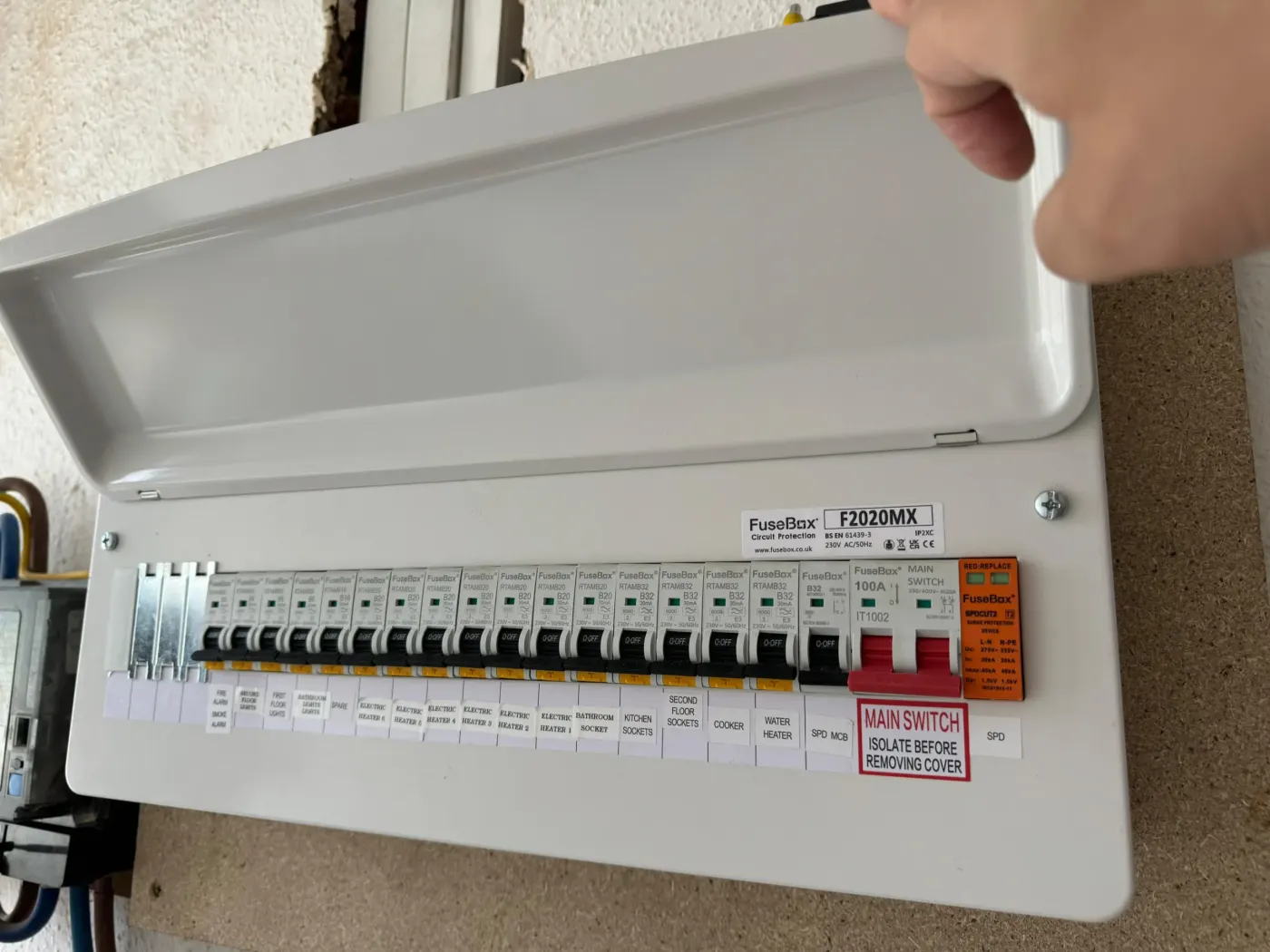
Reading your consumer unit (fuse board)
- 1Main switch. Turns off the power to the whole property. It rarely trips by itself.
- 2RCD. Protects a bank of circuits. If it's down, every circuit after it is off.
- 3Circuit breakers (MCBs). One per circuit, such as kitchen sockets or upstairs lights.
- 4Tripped. A switch pointing down has tripped. Here, only that one circuit is off.
Why does my RCD trip at the same time every night?
If the trip always happens at roughly the same time, something on a timer is almost certainly switching on. An RCD only trips when it detects current leaking to earth, so a trip at a regular hour means a device is starting up on a schedule and it has a leakage problem.
The same logic applies to weather. If trips only come with rain, damp is getting into part of the installation, usually outdoors.
Which appliances cause trips overnight?
Many households use cheaper overnight electricity tariffs or delayed-start programmes, which is why the evening and night are so often the trigger. Common causes include:
- Immersion heaters on a timer, where the heating element has started to leak to earth as it ages or scales up.
- Electric storage heaters that charge overnight, particularly older ones.
- Dishwashers, washing machines and tumble dryers with a delayed start, which heat water or air soon after they start.
- Garden lighting, pond pumps, outdoor heaters and security lights that come on when it gets dark.
- Fridges, freezers and other appliances that cycle on and off by themselves.
How do I work out what is tripping my RCD at night?
Make a note of the time of each trip for a few nights. If it fits with a timer, the culprit is whatever is scheduled for that time. Check the time controls on your immersion heater, heating, dishwasher and outdoor lighting.
If you cannot find a link, check whether the fridge or freezer is involved. These cycle on at different times and an older compressor can leak enough to trip an RCD. A tripped RCD overnight can also let a freezer thaw, so check the contents the next morning.
Why does my RCD trip when it rains?
Water and electricity do not mix, and rain tests the outdoor parts of an installation. Wet-weather trips usually come from one of the following.
- Outdoor sockets with damaged covers or poor seals.
- Garden lights, with cracked housings or loose connectors.
- The supply cable to a shed, garage or garden room, where the cable may have been damaged or the outer sheath has perished.
- A damaged or unsuitable external junction box, where water gets in.
- Outside lights, doorbells, extractor fan outlets and security cameras with failed seals.
- Damp in a wall or ceiling that is letting water reach cables or fittings.
What do IP ratings mean for outdoor electrics?
An IP (ingress protection) rating shows how well a fitting resists solids and water. The first digit covers solids such as dust and the second covers water. For example, IP44 means protected against splashing water from any direction, and IP65 means protected against dust and low-pressure water jets.
Outdoor fittings should carry a rating suited to where they are used. As a general guide, exposed locations need a higher second digit than sheltered ones. Fittings should be installed as the manufacturer intends, with the seals, glands and covers in place. An ordinary indoor socket or junction box fitted outside is a common cause of rain trips,.
How to find the fault safely
You can run simple checks without touching any wiring or opening anything.
- Note the time of day, the weather and what was running when the trip happened.
- Switch off, then unplug, anything outdoors that is plugged in, such as garden lights, pumps, heaters and power tools. Only handle them if they and your hands are dry and you are standing somewhere dry.
- For items on timers, switch them off at the appliance or unplug them. For an immersion heater or storage heater, switch off at its own switch if there is one.
- Reset the RCD at the consumer unit by pushing the switch firmly up. Do not open the cover.
- Reintroduce items one at a time over a few days, starting with indoor ones. Leave outdoor items until last.
- Look at outdoor sockets, lights and boxes from a safe distance for cracked covers, missing seals, water inside or discolouration. Do not open them or wipe them down while the power is on.
- If the RCD trips again when everything on your list is off, or trips every time it rains, stop and call an electrician.
What if the trip happens with everything switched off?
If the RCD still trips overnight or in rain with every plug-in item off, the fault is likely in fixed wiring, a wired-in appliance or an outdoor supply cable. Examples are an underground cable to a garage, a buried or surface-run cable that has been nicked, or a fused spur feeding an outdoor light. These cannot be traced without testing equipment.
Do not try to isolate or repair the cable yourself. Keep the affected circuit off if you can identify it, and arrange a test.
When to call an electrician
Call an electrician if the RCD trips straight away, trips every time it rains, or trips with all plug-in items removed. You should also call if you see water inside an outdoor fitting, a damaged cable, cracked or melted plastic, or smell burning.
An electrician can test the circuit's insulation, locate a damaged cable and replace unsuitable outdoor fittings with ones of a suitable IP rating. PowerArc has a 24/7 emergency line on 07775 512758 if a trip leaves you without power or it feels unsafe to wait.
General information for homes in England, written by the electricians at PowerArc Ltd, Hornchurch. Last updated 16 October 2026. For advice on your own property, speak to one of our electricians.